


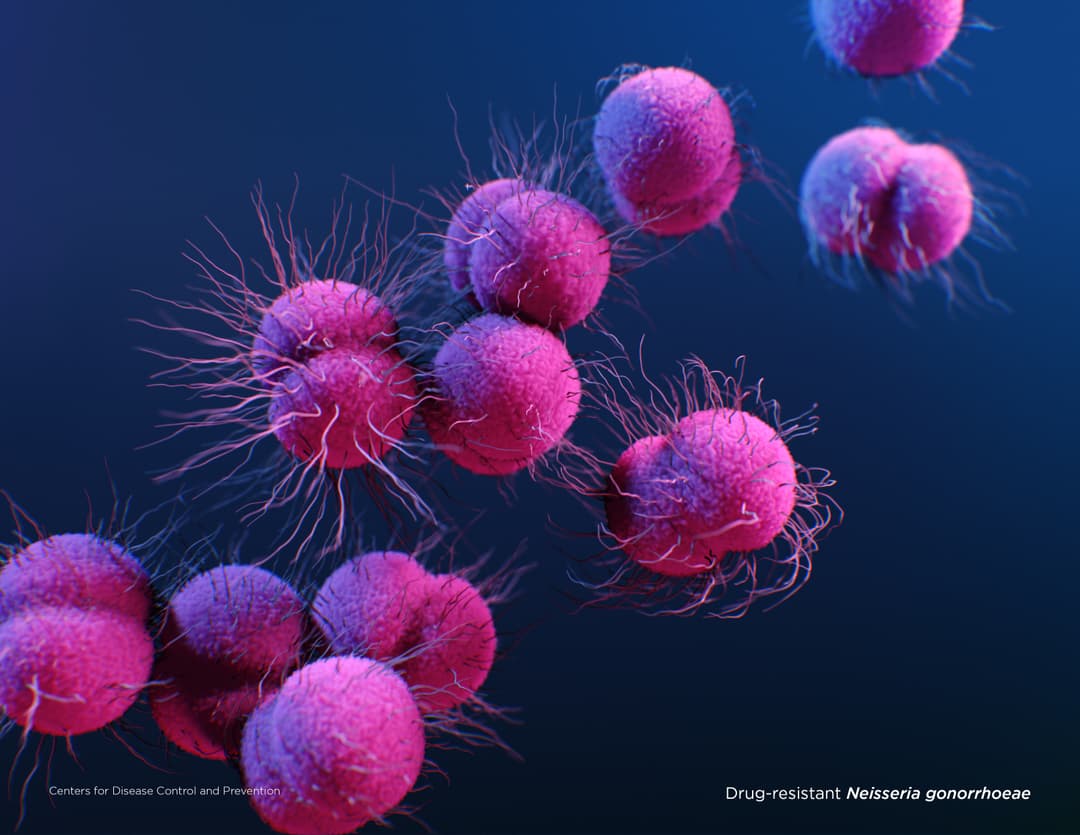
Centers for Disease Control and Prevention

Drug-resistantNeisseria gonorrhoeae

Threat Level: URGENT

In the United States in 2023:

CDC changed methodologies and data sources to produce the most comprehensive AR Threats Report to date. Direct comparison of this threat's data to previous reports is not recommended.

What you need to know

Neisseria gonorrhoeae (N. gonorrhoeae), the bacteria that cause the sexually transmitted infection gonorrhea, can result in pelvic inflammatory disease, life-threatening ectopic pregnancy, and infertility; can increase the risk of getting and giving HIV; and may result in a rare, severe complication called disseminated gonococcal infection. Sexually active people can get gonorrhea from sex without a condom with someone who has the infection. A pregnant woman with gonorrhea can also pass the infection to her baby during childbirth.

Gonorrhea has developed resistance to nearly all antibiotics used for treatment. Healthcare providers only have a few antibiotics that can effectively treat this infection. To slow the spread of gonorrhea and emergence of new resistance in the United States, access to antibiotics that successfully treat these infections is critical.

Drug-resistant Neisseria gonorrhoeae data

The estimated number of drug-resistant Neisseria gonorrhoeae (N. gonorrhoeae) infections has remained above 740,000 since 2018.

Estimated number of drug-resistant Neisseria gonorrhoeae infections by year in the U.S.

The estimated number of drug-resistant N. gonorrhoeae infections increased from 2018 to 2021 before decreasing in 2022 and 2023. The credible intervals (range of values likely to include the true value) for the yearly estimates overlap during 2018 to 2023, suggesting that assessment of changes from year to year should be made cautiously.

Percent resistance or elevated MICs to any of 6 antibiotics by year among Neisseria gonorrhoeae infections in the U.S.

Gonococcal isolates (pure samples of N. gonorrhoeae) are tested for resistance or elevated minimum inhibitory concentrations (MICs)—the lowest concentration of an antibiotic that will stop the growth of a bacterial isolate—to six antibiotics: azithromycin, ceftriaxone, cefixime, ciprofloxacin, tetracycline, and penicillin. Resistance or elevated MICs to any of these antibiotics ranged from a high of 55.5% in 2019 to a low of 47.8% in 2022. After 2022, there was an abrupt increase to 55.4% in 2023. The increase in resistance between 2022 and 2023 was driven by increases in resistance to antibiotics no longer recommended to treat gonorrhea, including tetracycline, penicillin, and ciprofloxacin. CDC will continue monitoring to determine if this increased resistance to multiple antibiotics is an anomaly or the beginning of a concerning trend. Resistance to ceftriaxone, the current recommended treatment option, remained very rare from 2018 to 2023.

The estimated total lifetime medical costs for all drug-resistant N. gonorrhoeae infections in 2023 remained high at nearly $215 million; estimated costs had previously peaked at nearly $270 million in 2020 and 2021.

Increase in disseminated gonococcal infections reported in two U.S. states

Two laboratorians looking at a petri dish held up to the light.

CDC shares antimicrobial susceptibility testing and whole genome sequencing findings to help jurisdictions respond to outbreaks.

Increasing reports of disseminated gonococcal infection (DGI), a rare, severe complication that may develop when gonorrhea is untreated, in two U.S. states signaled a troubling trend. Between 2023 and 2024, Alaska's Section of Epidemiology (SOE) detected a DGI outbreak after cases increased nearly four-fold. In 2024, the Minnesota Department of Health (MDH) also saw DGI cases increase four-fold. This sparked public health concerns as DGI can result in severe health conditions including septic arthritis (joint infection), endocarditis (infected heart valve), meningitis (infection around the brain and spinal cord), and osteomyelitis (bone infection). These complications can require hospitalization and surgery, and in rare cases, cause death.
In response to these outbreaks, SOE and MDH worked with CDC to analyze DGI clinical samples. CDC used antimicrobial susceptibility testing to identify bacteria sensitivity to different antibiotics, and whole genome sequencing to identify the strain type and detect potential virulence markers. These markers help indicate if a strain may be more likely to cause a severe infection, and some jurisdictions have used this information to help with outbreak investigations.
CDC's partnerships with SOE and MDH helped identify and respond to gonorrhea strains linked to severe infections. This type of collaboration is an effective way to address future outbreaks of gonorrhea that may be more severe or harder to treat.
How CDC combats drug-resistant Neisseria gonorrhoeae

  • Conducting case-based surveillance

    CDC conducts surveillance to collect and report information about cases of Neisseria gonorrhoeae (N. gonorrhoeae) nationwide.

  • Expanding lab and response capacities in states

    CDC and state and local health departments use data collected from 21 jurisdictions through Combatting Antimicrobial Resistant Gonorrhea and Other STIs (CARGOS), an enhanced surveillance, rapid detection, and response program that monitors trends in drug-resistant N. gonorrhoeae. CARGOS expands laboratory and data infrastructure capacity to help states better understand risk factors, transmission, and emerging resistance trends for N. gonorrhoeae. The program has increased culture-based laboratory testing from nine to 21 jurisdictions, allowing for enhanced investigations into ongoing spread of N. gonorrhoeae.

  • Supporting health departments

    CDC provides guidance and assistance for N. gonorrhoeae infection prevention, control, and response. Since 2022, CDC has provided medical, laboratory, and public health assistance for 94 cases across 33 jurisdictions in which healthcare providers suspected a patient's gonorrhea treatment was unsuccessful.

  • Ensuring recommended treatments are effective

    Four labs in CDC's Antimicrobial Resistance Laboratory Network perform antimicrobial susceptibility testing on about 5,000 N. gonorrhoeae samples every year to determine how sensitive N. gonorrhoeae is to different antibiotics and to monitor emerging resistance trends. Data are used to update N. gonorrhoeae treatment recommendations in the United States.

  • Optimizing lab technology

    CDC uses whole genome sequencing to support response efforts and identify mutations associated with antimicrobial resistance. Over 3,300 N. gonorrhoeae isolates are sequenced every year.

  • Advancing scientific knowledge, treatments, and diagnostics

    CDC provides researchers and manufacturers access to CDC's gonorrhea specimen bank containing 50,000 unique samples—the largest in the world—to assist with the development of new diagnostics and treatments. N. gonorrhoeae isolates are also available through CDC and FDA's Antimicrobial Resistance Isolate Bank.

Drug-resistant Neisseria gonorrhoeae resources

Illustration for Drug-resistant Neisseria gonorrhoeae