

These are the bacteria and fungi included in CDC's Antimicrobial Resistance Threats Report, categorized by level of threat to human health in the United States—urgent, serious, concerning—and a Watch List of potential threats.
Urgent Threats
These pathogens are public health threats that require urgent and aggressive action.
Serious Threats
These pathogens are public health threats that require prompt and sustained action.
- Clostridioides difficile (C. diff)
- Drug-resistant Campylobacter
- Drug-resistant Candida
- Drug-resistant Mycobacterium tuberculosis
- Drug-resistant Neisseria meningitidis
- Drug-resistant nontyphoidal Salmonella
- Drug-resistant Salmonella Typhi
- Drug-resistant Shigella
- Drug-resistant Streptococcus pneumoniae
- Extended-spectrum cephalosporin-resistant Enterobacterales (ESC-RE)
- Methicillin-resistant Staphylococcus aureus (MRSA)
- Multidrug-resistant Pseudomonas aeruginosa
- Vancomycin-resistant Enterococcus (VRE)
Concerning Threats
These pathogens are public health threats that require careful monitoring and prevention action.
Watch List
These pathogens are being monitored as potential threats, as their full burden is not yet understood.
How CDC Assessed and Assigned Threat Level
The Antimicrobial Resistance Threats Report assesses threats according to seven factors:
- Clinical impact
- Economic impact
- Current number of new infections identified in the United States
- Projected change in the number of new infections over the next five years in the United States
- Transmissibility, or how easily a pathogen spreads or causes infections
- Preventability or the availability, effectiveness, and extent of prevention measures—such as pathogen-specific infection control recommendations or vaccines—and barriers that exist for widespread prevention
- Availability of effective antibiotics, antifungals, and treatments
CDC focuses on domestic impact when assessing and assigning threat level. In some cases, the international context of antimicrobial resistance is considered, for instance, when it impacts U.S. citizens traveling internationally and returning home.
Methods to Determine Overall Burden Estimates
CDC aggregated the 2023 estimates for the 19 urgent, serious, and concerning threats identified in this report to estimate the total number of infections and deaths and associated statistical uncertainty. For more detailed information, read AR Threats Report Infections and Deaths Aggregation Methods.
Changes Since Last Threats Report
New additions
- Drug-resistant Neisseria meningitidis – Added in 2026 as a serious threat that requires prompt and sustained action.
- Drug-resistant dermatophytes – Added to the Watch List in 2026 as the burden of disease in the United States is not yet understood but is being monitored as a potential threat.
- Drug-resistant Haemophilus influenzae (Hi) – Added to the Watch List in 2026 as the full burden of resistance in the United States is not yet understood but is being monitored as a potential threat.
- Nontuberculous mycobacteria (NTM) – Added to the Watch List in 2026 as the burden of disease in the United States is not yet understood but is being monitored as a potential threat.
Data changes
- The 2026 update to the AR Threats Report provides the most comprehensive estimate of the impact of drug-resistant pathogens on human health in the United States to date. CDC’s methodologies and data sources changed substantially between previous reports and the 2026 update to the AR Threats Report for all pathogens except C. auris. Therefore, direct comparisons between reports should not be made.
- Extended-spectrum beta-lactamase (ESBL)-producing Enterobacteriaceae changed to extended-spectrum cephalosporin-resistant Enterobacterales (ESC-RE) to include additional pathogens Enterobacter spp. and Klebsiella aerogenes, in addition to pathogens previously included in the definition.
- Drug-resistant group A Streptococcus previously only included data on invasive infections but was expanded in 2026 to also include non-invasive infections. Erythromycin-resistant group A Streptococcus was renamed to drug-resistant group A Streptococcus in 2026 to account for increasing resistance to both macrolides and clindamycin.
- Clindamycin-resistant group B Streptococcus previously only included data on invasive infections but was expanded in 2026 to also include non-invasive infections.
- Clostridioides difficile (C. diff) previously only included hospitalized C. diff cases. This report includes both hospitalized and non-hospitalized C. diff cases, offering a more comprehensive picture of C. diff’s burden in the United States
Category changes
- Clostridioides difficile (C. diff) transitioned from an urgent to a serious threat in 2026 due in part to successful infection prevention actions, especially in healthcare settings where CDC has measured declines in cases since 2011. Still, C. diff causes substantial infections, deaths, and healthcare costs in the United States. C. diff remains one of the most common causes of healthcare-associated infections in hospitals, and there is an even greater number of community-associated cases. Continued infection control and appropriate antibiotic use remain important for sustaining progress in reducing C. diff infections. CDC will continue to monitor trends in C. diff burden and the potential for the development of resistance to treatments. For more information, read C. diff Data Methods.
Resources

The list of bacteria and fungi in CDC's Antimicrobial Resistance Threats Report categorized by their level of threat to human health.
DownloadPDF
The list of bacteria and fungi in CDC's Antimicrobial Resistance Threats Report categorized by their level of threat to human health and a Watch List of pathogens being monitored as potential threats.
DownloadPDF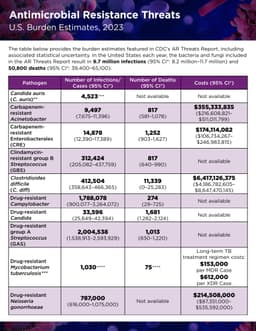
A table showing the burden estimates featured in CDC’s AR Threats Report, including associated statistical uncertainty.
DownloadPDF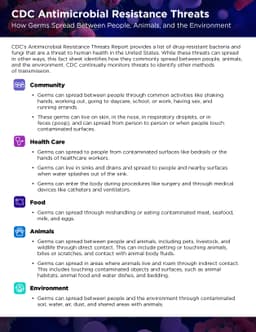
Information on how AR threats commonly spread between people, animals, and the environment.
DownloadPDFSuggested Citation
Centers for Disease Control and Prevention. Antimicrobial Resistance Threats Report. U.S. Department of Health and Human Services. October 27, 2026. https://arthreats.cdc.gov