



Centers for Disease Control and Prevention

Multidrug-resistantPseudomonas aeruginosa

Threat Level: SERIOUS

In the United States in 2023:

CDC changed methodologies and data sources to produce the most comprehensive AR Threats Report to date. Direct comparison of this threat's data to previous reports is not recommended.

What you need to know

Pseudomonas bacteria commonly live in the environment—such as in soil and water—and on surfaces, including in healthcare facilities. The bacteria thrive in moist or wet places, including sinks and icemakers in healthcare settings. The most common type of these bacteria to cause infections in humans is Pseudomonas aeruginosa (P. aeruginosa). People can carry P. aeruginosa on their skin and in their body without having signs or symptoms of infection. People carrying P. aeruginosa can spread the bacteria to surfaces and objects around them, which can result in spread of the bacteria to other people. P. aeruginosa can cause infections in almost any body site, including the lungs, wounds, urinary tract, and blood.

Some P. aeruginosa can be resistant to multiple antibiotics. Multidrug-resistant P. aeruginosa bacteria are often resistant to some of our most powerful antibiotics used to treat infections, including carbapenem antibiotics. These resistant bacteria are a major concern for patients in healthcare settings, where they can spread quickly and cause outbreaks. Patients at higher risk of infection include those who have recently been on antibiotics, stayed in an intensive care unit, have medical devices (like ventilators or catheters), or had a long hospital or nursing home stay. Multidrug-resistant P. aeruginosa infections may have very limited treatment options, resulting in healthcare providers prescribing treatments that are less effective.

Multidrug-resistant Pseudomonas aeruginosa data

In 2023, there were an estimated 18,939 cases of multidrug-resistant Pseudomonas aeruginosa (P. aeruginosa) in hospitalized patients and 1,588 people who died due to their multidrug-resistant P. aeruginosa infection. CDC estimates that multidrug-resistant P. aeruginosa cases were responsible for more than $537 million in healthcare costs in 2023. Because multidrug-resistant P. aeruginosa infections can be difficult or impossible to treat, infection prevention and control measures are critical.

Number of multidrug-resistant Pseudomonas aeruginosa cases in hospitalized patients (N=18,939) by location of onset and specimen type in 2023 in the U.S.

Invasive multidrug-resistant P. aeruginosa cases
Non-invasive multidrug-resistant P. aeruginosa cases

In 2023, 32% of multidrug-resistant P. aeruginosa cases in hospitalized patients were hospital-onset and 68% were community-onset. Hospital-onset cases occur when specimens (samples) taken from patients on or after day four of hospitalization test positive for multidrug-resistant P. aeruginosa. Community-onset cases occur when specimens taken from patients immediately before or within the first three days of hospitalization test positive for multidrug-resistant P. aeruginosa. Community-onset cases may be in patients with recent healthcare exposure prior to their hospitalization, including nursing home residents.

Four percent of hospital-onset multidrug-resistant P. aeruginosa cases and 3% of community-onset multidrug-resistant P. aeruginosa cases were invasive. Invasive cases mean multidrug-resistant P. aeruginosa bacteria are found in normally sterile (free from germs) body sites, such as blood or cerebrospinal fluid. Non-invasive cases mean multidrug-resistant P. aeruginosa bacteria are found in non-sterile sites, such as the urinary tract, the respiratory tract, or wounds.

Most reported multidrug-resistant P. aeruginosa cases are non-invasive. Non-invasive infections can be mild or severe, and some non-invasive infections, like pneumonia, can be deadly. Invasive infections are very serious and can be deadly, often resulting in significant healthcare needs, antibiotic use, and an increased risk for sepsis. Preventing multidrug-resistant P. aeruginosa infections, whether they are invasive or non-invasive, is critically important, since they can be difficult to treat.

For the first time, data from the National Healthcare Safety Network (NHSN) Antimicrobial Use and Resistance Module were used to estimate the burden of multidrug-resistant P. aeruginosa as shown in the figure above.

For the figure below, CDC used healthcare-associated infection data reported to a different NHSN module to review changes in the percent resistance over time for multidrug-resistant P. aeruginosa.

Crude annual percentage of Pseudomonas aeruginosa with multidrug resistance among selected healthcare-associated infection types by year

New resistance definition for multidrug-resistant P. aeruginosa implemented in 2021

In the decade leading up to 2020, there were declines in the percentage of P. aeruginosa with multidrug resistance that caused selected types of healthcare-associated infections reported to NHSN. Between 2011 and 2020, the percentage of P. aeruginosa central line-associated bloodstream infections (CLABSI) with multidrug resistance decreased from 21.7% to 12.2%. During that same time period, the percentage of P. aeruginosa catheter-associated urinary tract infections (CAUTI) with multidrug resistance decreased from 18.6% to 9.5%. Between 2012 and 2020, the percentage of P. aeruginosa surgical site infections (SSI) with multidrug resistance decreased from 5.5% to 3.6% [1].

Although there is more to do to protect patients from multidrug-resistant P. aeruginosa, these declines provide evidence that infection prevention and control measures work.

In 2021, a new resistance definition was implemented in NHSN, and the percentages of P. aeruginosa with multidrug resistance appear to be stable during 2021 to 2023 [1]. It is important to keep monitoring trends in multidrug-resistant P. aeruginosa to guide actions to protect people.

Multidrug-resistant Pseudomonas aeruginosa in artificial tears
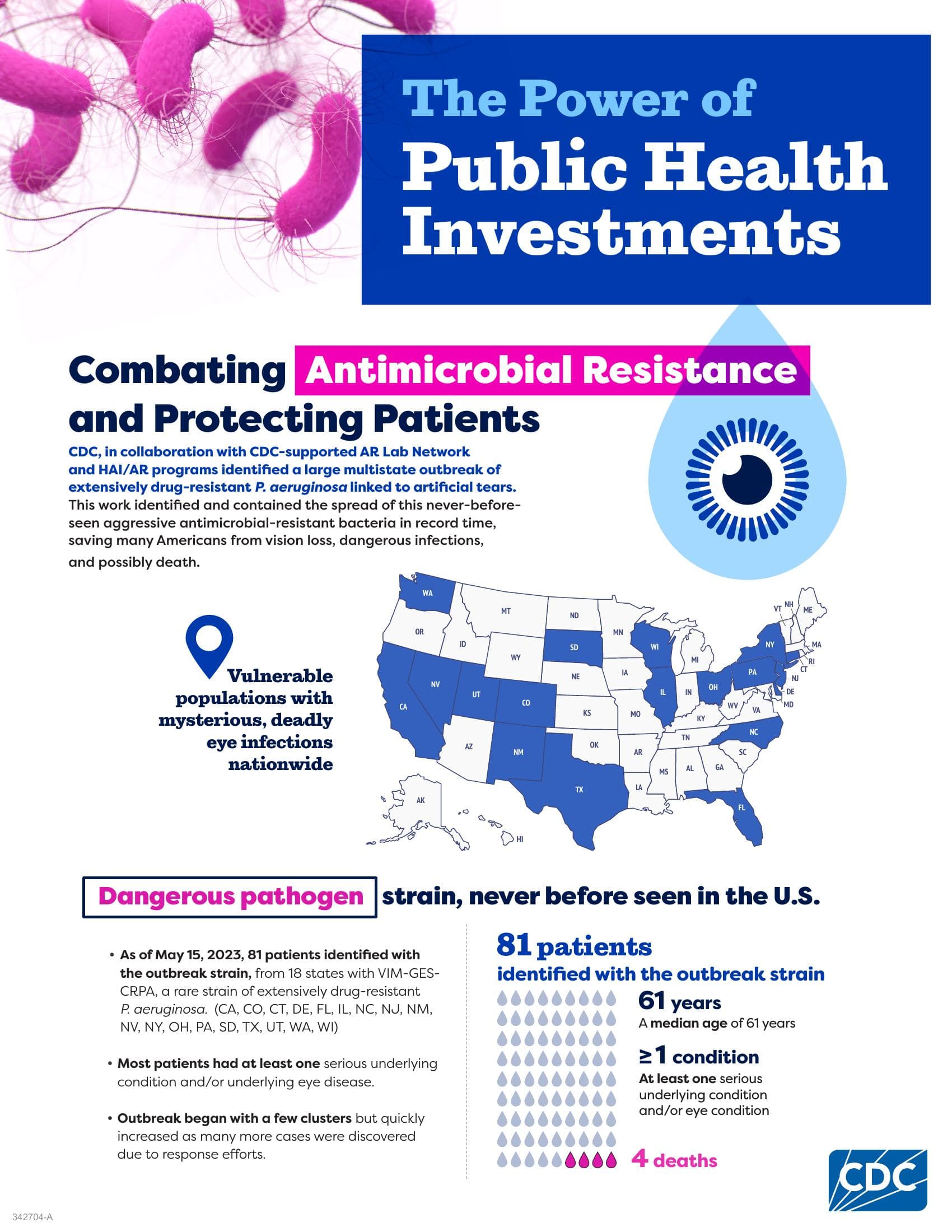
Infographic on the power of public health investments and combating antimicrobial resistance and protecting patients.

Download an infographic about how CDC's AR Lab Network helped solve a 2022 outbreak of extensively drug-resistant P. aeruginosa in artificial tears.

In June 2022, health officials across the United States investigated outbreaks of extensively drug-resistant Pseudomonas aeruginosa (P. aeruginosa) in several states. Extensively drug-resistant P. aeruginosa are highly resistant and have very limited treatment options. Patients had infections such as pneumonia, urinary tract infections, and eye infections. Before they became ill, they were cared for in many kinds of healthcare facilities, from outpatient clinics to long-term acute care hospitals.
CDC determined that the extensively drug-resistant P. aeruginosa outbreaks across states shared the same genetic fingerprint, suggesting the same source and triggering a nationwide investigation. CDC worked with the U.S. Food and Drug Administration and state and local health departments to determine which medical products patients used prior to getting sick. Samples from around the country were sent to labs in CDC's Antimicrobial Resistance Laboratory Network, where scientists used whole genome sequencing and other specialized tools to identify the cause.
Ultimately, CDC and public health partners identified 81 patients from 18 states with the outbreak strain of extensively drug-resistant P. aeruginosa. Investigators traced the source to imported, contaminated artificial tears (over-the-counter eye drop products used for dry eyes)—the first time these extensively drug-resistant P. aeruginosa had been linked to a manufactured product. Thanks to fast action, strong partnerships, and CDC's support of advanced laboratory capabilities in health departments nationwide, the outbreak was stopped before more people were harmed.

How CDC combats multidrug-resistant Pseudomonas aeruginosa

  • Supporting laboratory capacity and testing

    CDC supports the Antimicrobial Resistance Laboratory Network so that health departments can quickly identify local drug-resistant Pseudomonas aeruginosa (P. aeruginosa) cases and track trends in resistance in healthcare settings. This testing can inform infection prevention experts, outbreak response, and national guidance to protect patients from P. aeruginosa.

  • Tracking infections

    CDC's National Healthcare Safety Network identifies and measures healthcare-associated infections, including those caused by multidrug-resistant P. aeruginosa, in healthcare facilities nationwide to inform antibiotic stewardship and infection prevention efforts, and alert experts to new resistance trends.

  • Collaborating through partnerships

    CDC works closely with health departments, other federal agencies, healthcare facilities and providers, and patients to prevent infections caused by P. aeruginosa and stop the spread of resistant bacteria.

Multidrug-resistant Pseudomonas aeruginosa resources

Illustration of Multidrug-resistant Pseudomonas aeruginosa