



Centers for Disease Control and Prevention

Carbapenem-resistant Enterobacterales

Threat Level: URGENT

In the United States in 2023:

CDC changed methodologies and data sources to produce the most comprehensive AR Threats Report to date. Direct comparison of this threat's data to previous reports is not recommended.

What you need to know

Enterobacterales are a group of bacteria that live in the intestines of people and animals. Although some of these bacteria normally live in our bodies without causing problems, they can cause infections in the urinary tract, blood, and other parts of the body. Common Enterobacterales include Escherichia coli (E. coli) and Klebsiella.

Some Enterobacterales are resistant to a group of our most powerful antibiotics used to treat infections, known as carbapenem antibiotics. Carbapenem-resistant Enterobacterales (CRE) are a major concern for patients in healthcare settings. Patients who have medical devices, like ventilators or catheters, and those taking long courses of some antibiotics, may be at higher risk of developing CRE infections. CRE infections have limited treatment options. As a result, healthcare providers may have to prescribe treatments that are less effective.

Some CRE produce enzymes called carbapenemases, which enable the bacteria to destroy carbapenems. These carbapenemase-producing CRE are known as CP-CRE and are especially concerning because they can spread quickly and cause outbreaks in healthcare facilities.

Carbapenem-resistant Enterobacterales data

In 2023, there were an estimated 14,878 cases of carbapenem-resistant Enterobacterales (CRE) in hospitalized patients and 1,252 people who died due to their CRE infection. CDC estimates that CRE cases were responsible for more than $174 million in healthcare costs in 2023. With recent, rapid increases in carbapenemase-producing CRE (CP-CRE), more people may develop CRE infections and deaths may increase.

Number of carbapenem-resistant Enterobacterales (CRE) cases in hospitalized patients (N=14,878) by location of onset and specimen type in 2023 in the U.S.

In 2023, 33% of CRE cases in hospitalized patients were hospital-onset, and 67% were community-onset. Hospital-onset cases occur when specimens (samples) taken from patients on or after day four of hospitalization test positive for CRE. Community-onset cases occur when specimens taken from patients immediately before or within the first three days of hospitalization test positive for CRE. Community-onset cases may be in patients with recent healthcare exposure prior to their hospitalization, including nursing home residents.

Nine percent of hospital-onset CRE cases and 10% of community-onset CRE cases were invasive. Invasive cases mean CRE are found in normally sterile (free from germs) body sites, such as blood or cerebrospinal fluid. Non-invasive cases mean CRE are found in non-sterile sites, such as the urinary tract, the respiratory tract, or wounds.

Most reported CRE cases are non-invasive. Non-invasive infections can be mild or severe, and some non-invasive infections, like pneumonia, can be deadly. Invasive infections are very serious and can be deadly, often resulting in significant healthcare needs, antibiotic use, and an increased risk for sepsis. Preventing CRE infections, whether they are invasive or non-invasive, is critically important, since they can be difficult to treat.

For the first time, data from the CDC National Healthcare Safety Network (NHSN) Antimicrobial Use and Resistance Module were used to estimate the burden of CRE as shown in the figure above.

For the figure below, data from a complementary CDC program, the Antimicrobial Resistance Laboratory Network (AR Lab Network), were used to examine changes over time in the incidence rates of CP-CRE. The AR Lab Network tracks the emergence and spread of specific strains of CP-CRE and shares the data with public health partners to help inform response, prevent spread, and protect people.

Unadjusted carbapenemase-producing carbapenem-resistant Enterobacterales (CP-CRE) incidence per 100,000 persons by carbapenemase and year

A previously published analysis using data from CDC's AR Lab Network, shown in the figure above, indicates that the types of CP-CRE affecting U.S. patients changed dramatically from 2019 to 2023 [1]. Between 2019 and 2023, the AR Lab Network detected a nearly five-fold increase in the incidence of a type of CP-CRE called New Delhi metallo-β-lactamase-producing carbapenem-resistant Enterobacterales (NDM-CRE) and a smaller increase in another type of CP-CRE (oxacillinase-48-like β-lactamase-producing CRE, or OXA-48-like-CRE). Klebsiella pneumoniae carbapenemase-producing CRE (KPC-CRE)—historically the most common CP-CRE in the United States—remained stable, but NDM-CRE has risen fast and was nearly as common by 2023. The increase in NDM-CRE adds to the existing burden of CP-CRE in the United States. Because treatment of CP-CRE infections should be tailored to the type of carbapenemase the bacteria produce, these changes make treatment of CRE infections even more complex.

Iowa's containment approach stops the spread of drug-resistant threats in high-risk facilities
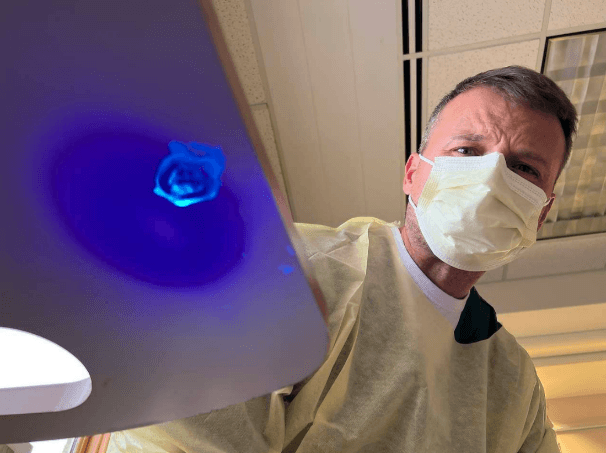
An infection prevention expert using a black light to check the underside of a table in a patient room.

An infection prevention expert uses a black light to check if the surface on the underside of a table in a patient room was cleaned. This kind of hands-on check is part of CDC's Infection Control Assessment and Response (ICAR) tools, which help healthcare facilities find and fix infection prevention gaps before they put patients at risk.

Carbapenem-resistant Enterobacterales (CRE) can spread silently in healthcare facilities, sometimes fueling large outbreaks that are hard to stop. Because CRE cause some of the hardest-to-treat infections, CDC recommends that health departments implement prevention strategies to identify cases early and that healthcare facilities launch an infection prevention and control response in areas where CRE are uncommon at the first sign of even one case—called “containment.” With CDC funding, the Iowa Department of Health and Human Services (HHS) built a proactive surveillance approach to catch CRE cases early, before they grow into outbreaks.
One Iowa healthcare facility conducted testing to screen its patients for resistant bacteria, identifying three CRE cases. The facility partnered with Iowa HHS to launch an immediate public health containment response. Iowa HHS's Healthcare-Associated Infections (HAI) Team used CDC's Infection Control Assessment and Response (ICAR) tool, then recommended a multifaceted plan to protect patients and prevent further spread of CRE. The plan included facility-wide staff training on hand hygiene and use of personal protective equipment, stronger protocols for identifying CRE-positive residents on admission and transfer, enhanced environmental cleaning of shared patient equipment, and more targeted antibiotic use. Improvements reached every department of the facility, from administration to environmental services.
Thanks to this swift response, follow-up testing confirmed the outbreak was successfully controlled. Iowa HHS points to this facility's experience as proof of the value of proactive screening—and of the strong relationships between facilities, health departments, and CDC that make containment possible.

How CDC combats carbapenem-resistant Enterobacterales

  • Supporting laboratory capacity and testing

    CDC supports the Antimicrobial Resistance Laboratory Network so that health departments can quickly identify local carbapenemase-producing CRE (CP-CRE) threats and track trends in resistance in healthcare settings. This testing can inform infection prevention experts, outbreak response, and national guidance to protect patients from CP-CRE. CDC encourages clinical laboratories to expand specialized mechanism testing for CP-CRE to identify what carbapenemases are present. This information can help guide treatment and infection control decisions.

  • Tracking infections

    CDC monitors CRE infections and tracks resistance mechanisms through the National Healthcare Safety Network and the Emerging Infections Program to protect patients, guide strategies to prevent healthcare-associated infections (HAIs), and to measure progress of HAI prevention actions.

  • Collaborating through partnerships

    CDC works closely with health departments, other federal agencies, healthcare facilities and providers, and patients to prevent CRE infections and stop the spread of resistant bacteria. This includes communication efforts to encourage healthcare and public health professionals to stay aware of local CRE trends, use lab testing to determine the best treatment plan, and use appropriate infection control precautions to prevent further spread.

Carbapenem-resistant Enterobacterales resources

Illustration of Carbapenem-resistant Enterobacterales