

Saving lives through quick detection and targeted treatment

CDC laboratories work to quickly detect drug resistance and inform targeted treatment to help prevent deaths from drug-resistant infections.
Threat Level: SERIOUS
In the United States in 2023:
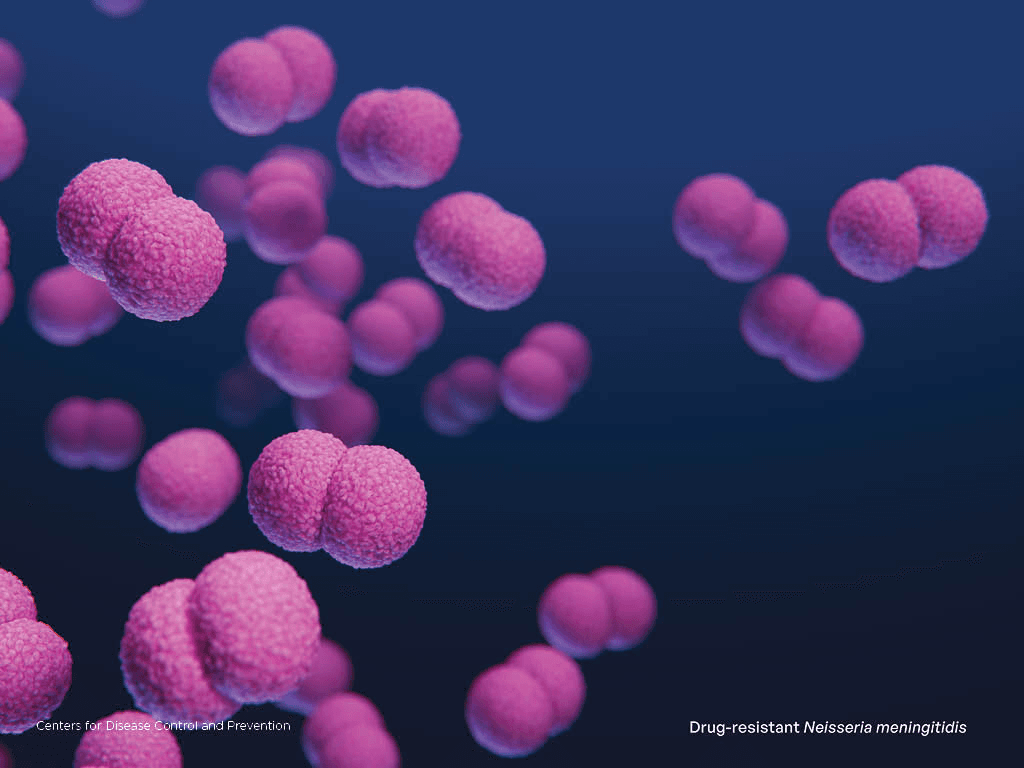
Neisseria meningitidis (N. meningitidis) are bacteria that can spread through respiratory droplets and close contact and cause meningococcal disease. Meningococcal disease is a rare, but life-threatening illness. The two most common types of meningococcal infections are meningitis (when the bacteria infect the lining of the brain and spinal cord) and bloodstream infections (when the bacteria infect blood). Meningococcal disease often impacts previously healthy people, especially young children, adolescents, and older adults. Those affected can become severely ill or die quickly.
Drug-resistant meningococcal disease is a growing concern in the United States despite the availability of effective treatments, prophylaxis (providing antibiotics to close contacts of those with meningococcal disease to prevent spread), and vaccination to prevent infection and slow spread. Having antibiotics that are effective against N. meningitidis is critical, both to prevent serious illness and death in people with infections and to protect those who have been in close contact with someone with this infection. Providing appropriate prophylaxis to those who have been exposed prevents illness and further spread and reduces the need for additional antibiotic use, which increases the risk for further development of resistance.
The estimated number of drug-resistant cases of Neisseria meningitidis (N. meningitidis) and the percent of cases resistant to ciprofloxacin and penicillin in the United States increased between 2019 and 2023.
Between 2019 and 2023, the estimated number of ciprofloxacin-resistant N. meningitidis cases more than doubled, and the estimated number of penicillin-resistant cases tripled. Counts are not mutually exclusive; cases may be resistant to both ciprofloxacin and penicillin and shown in both categories. Estimated cases were lower in 2021 and 2022, likely due to fewer opportunities for bacteria to spread during the COVID-19 pandemic. The credible intervals, or the range of values likely to include the true value, for the yearly estimates overlap during 2019 to 2022, suggesting that assessment of changes from year to year should be made cautiously.
Ongoing monitoring for drug resistance among N. meningitidis cases is important to inform treatment and prophylaxis recommendations. Penicillin is a recommended antibiotic for treatment of meningococcal disease, but there have been recent increases in penicillin resistance. Susceptibility of N. meningitidis to penicillin should be determined before healthcare providers switch treatment from a broad-spectrum antibiotic to penicillin or ampicillin (an antibiotic similar to penicillin). For prophylaxis, ciprofloxacin is a main (first-line) antibiotic given, but in some areas where ciprofloxacin-resistant N. meningitidis has been found, it may not effectively protect close contacts from becoming sick. Therefore, in those areas a different class of antibiotics will be required.
An estimated 5.8% of N. meningitidis cases during 2019 to 2023 were resistant to ciprofloxacin compared to 0.7% of cases during 2011 to 2018. Additionally, an estimated 10.3% of N. meningitidis cases during 2019 to 2023 were resistant to penicillin compared to 0.6% of cases during 2011 to 2018.
CDC laboratories work to quickly detect drug resistance and inform targeted treatment to help prevent deaths from drug-resistant infections.
Public health officials track all meningococcal disease cases in the United States. Health departments respond to every case to implement control measures, including providing prophylaxis to people who have been exposed to Neisseria meningitidis (N. meningitidis) to prevent additional cases from occurring.
CDC testing has detected N. meningitidis bacteria that are resistant to penicillin, ciprofloxacin, or both in the United States. These are important data that can guide decisions about which antibiotics healthcare providers should use to effectively treat patients and protect close contacts.
CDC has released public health strategies related to treatment, prophylaxis, and surveillance of drug-resistant N. meningitidis. In addition, CDC published guidance on changing meningococcal disease prophylaxis antibiotics in areas with ciprofloxacin resistance in the Morbidity and Mortality Weekly Report (MMWR) in February 2024. CDC continues to track which jurisdictions have discontinued use of ciprofloxacin jurisdiction-wide or in specified areas.

Learn how CDC analyzed data to develop the information and estimates shared on this page.
Learn about meningococcal disease – the types, causes, treatments, and prevention.
Review the latest news and meningococcal disease surveillance and trends.
Find CDC recommendations on prophylaxis for ciprofloxacin-resistant meningococcal disease.
Review this manual for guidance about surveillance activities for vaccine-preventable diseases.