

September 2023
Expanded Antimicrobial Susceptibility Testing for Hard-to-Treat Infections (ExAST): Guiding clinical healthcare decision-making through the Antimicrobial Resistance Laboratory Network
Antimicrobial Resistance Lab Network
What is Antimicrobial Susceptibility Testing?
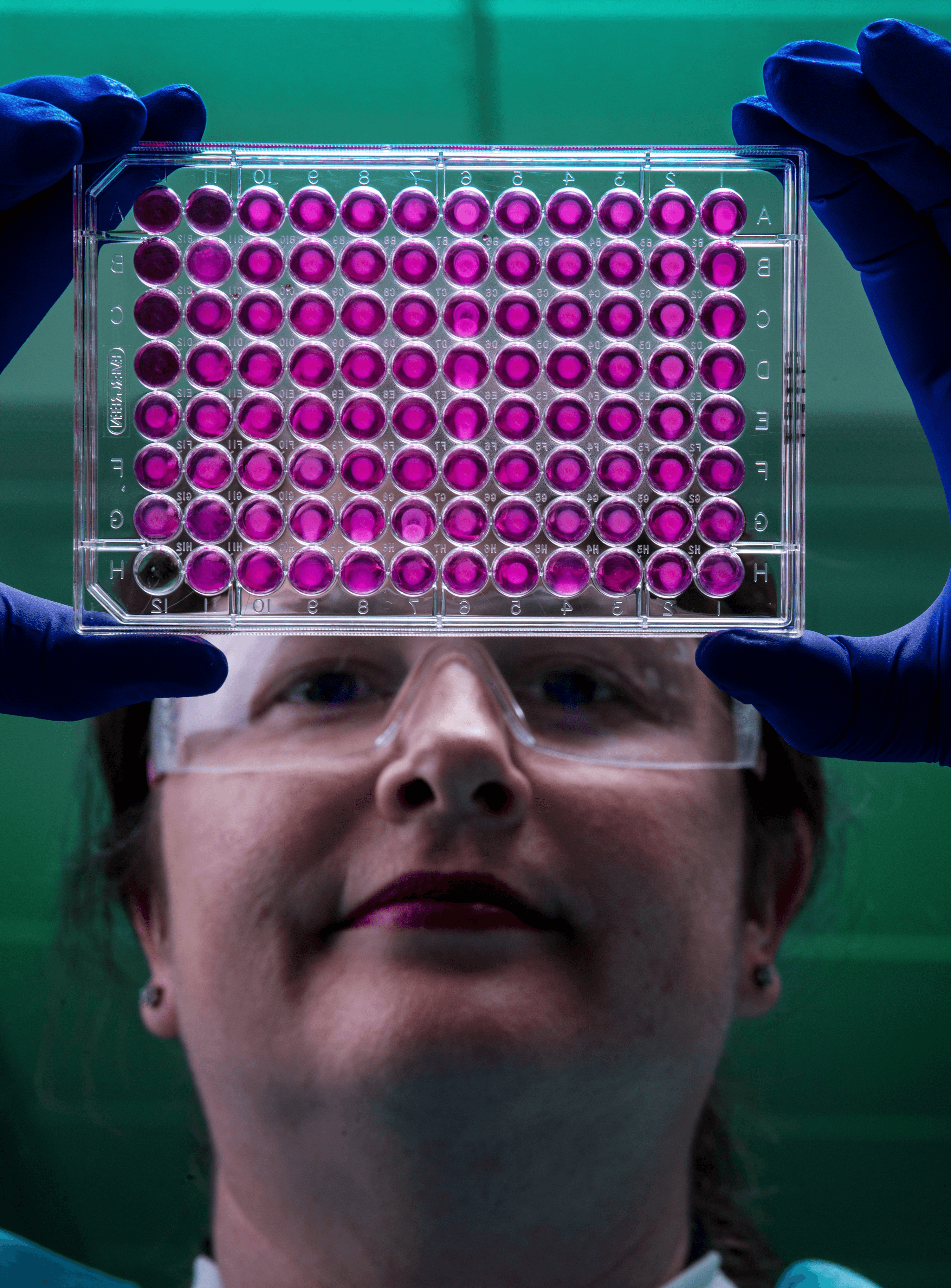
Antimicrobial susceptibility testing (AST) is a laboratory procedure that identifies which drugs may be effective for treating a patient's bacterial infection. When susceptibility testing is unavailable, healthcare providers are unable to determine whether a particular drug might be the right treatment for their patient. This means that the patient might not receive the most effective therapy to treat their infection, potentially leading to unnecessary side effects, treatment failures, or antimicrobial resistance. An AST method called broth microdilution (BMD) determines the minimum inhibitory concentration (MIC), which is the lowest concentration of an antibiotic that inhibits the growth of a bacterial isolate.
Testing New Drugs for Hard-to-Treat Enterobacterales Infections
According to current treatment guidance by the Infectious Diseases Society of America, ceftazidime-avibactam plus aztreonam is a preferred treatment for carbapenem-resistant infections caused by metallo-β-lactamase (MBL)-producing Enterobacterales, for which clinicians have few therapeutic options. Co-administering these two currently available drugs reproduces the activity of the drug combination aztreonam-avibactam, which has demonstrated efficacy in ongoing clinical trials for treating infections caused by MBL-producing Enterobacterales. The more common MBLs include NDM, VIM, and IMP carbapenemases.
The Expanded Antimicrobial Susceptibility Testing (ExAST) Program
In 2019, CDC's Antimicrobial Resistance Laboratory Network (AR Lab Network) introduced the ExAST Program (Expanded Antimicrobial Susceptibility Testing for Hard-to-Treat Infections) to fill this critical gap in patient care and public health response. ExAST leverages the infrastructure developed in the AR Lab Network to provide MICs to inform therapeutic decision-making for new antibiotics using an innovative technology - a digital printer! Using dispensing technology created by Hewlett Packard, the digital dispenser allows public health labs to create custom AST panels for drugs that aren't yet available on commercial panels.
Testing Aztreonam-Avibactam in The ExAST Program
To evaluate the potential effectiveness of using aztreonam-avibactam for hard-to-treat Enterobacterales infections, AR Lab Network microbiologists used BMD to determine each bacterial isolate's MIC for aztreonam and aztreonam-avibactam. These two MIC values were compared. Restored susceptibility is when an isolate that was not susceptible to aztreonam regains susceptibility with concurrent addition of avibactam. For these isolates with restored susceptibility, aztreonam-avibactam may be an effective treatment option.
Since 2019, aztreonam-avibactam AST has been performed on more than 200 isolates as part of the ExAST program. All isolates submitted were resistant to ceftazidime-avibactam and 90% were not susceptible to aztreonam. Most of the isolates tested produced an NDM carbapenemase (>85%), however, OXA-48, KPC, and IMP also were detected. Additionally, >15% of isolates produced more than one carbapenemase. Of all the isolates evaluated, MICs to aztreonam-avibactam were higher among E. coli compared to other species.
Of all isolates not susceptible to aztreonam, the addition of avibactam restored susceptibility to aztreonam for >80%. Importantly, aztreonam-avibactam's activity varied by which genus of Enterobacterales was tested, with Enterobacter andKlebsiella demonstrating 100% restored susceptibility, and E. coli demonstrating 60% restored susceptibility to aztreonam when tested against aztreonam plus avibactam.
In the figure below, review the MIC distributions for aztreonam, ceftazidime-avibactam, and aztreonam-avibactam for the 212 isolates described. With E. coli, notice the observable shift in the MIC distribution for aztreonam-avibactam when compared to other genera.
MIC DISTRIBUTIONS FOR AZTREONAM, AZTREONAM/AVIBACTAM, AND CEFTAZIDIME/AVIBACTAM IN MBL-POSITIVE ENTEROBACTERALES TESTED BY EXAST
| MIC (µg/mL) | Aztreonam | Aztreonam/Avibactam | Ceftazidime/Avibactam |
|---|---|---|---|
| 0.03 | 0 | 4 | 0 |
| 0.06 | 3 | 23 | 0 |
| 0.12 | 7 | 20 | 0 |
| 0.25 | 3 | 32 | 0 |
| 0.5 | 2 | 40 | 0 |
| 1 | 2 | 26 | 0 |
| 2 | 4 | 13 | 0 |
| 4 | 1 | 22 | 0 |
| 8 | 6 | 18 | 0 |
| 16 | 6 | 10 | 0 |
| 32 | 8 | 1 | 0 |
| 64 | 23 | 1 | 1 |
| 128 | 147 | 2 | 211 |
Click on the filter to explore the MIC distributions for all three drugs by genus.
Accessing ExAST Testing
There is no cost for ExAST testing provided by the AR Lab Network. Aztreonam-avibactam MIC testing is performed in the seven Regional Laboratories of the AR Lab Network. The turnaround time is less than three business days from the time of receipt. This service is available to clinicians, clinical-laboratories, and public health-laboratories.
Email your AR Lab Network Regional Laboratory to request testing and submission instructions.
References
- IDSA 2023 Guidance on the Treatment of Antimicrobial Resistant Gram-Negative Infections (idsociety.org)
- About the AR Lab Network
- Expanded Antimicrobial Susceptibility Testing (ExAST)
- Aztreonam-Avibactam Susceptibility Testing Program for Metallo-Beta-Lactamase-Producing Enterobacterales in the Antibiotic Resistance Laboratory Network, March 2019 to December 2020 - PubMed (nih.gov)
- Validation of Aztreonam-Avibactam Susceptibility Testing Using Digitally Dispensed Custom Panels - PubMed (nih.gov)
- Assessing the in vitro impact of ceftazidime on aztreonam/avibactam susceptibility testing for highly resistant MBL-producing Enterobacterales - PubMed (nih.gov)