

September 2023
THE ANTIMICROBIAL RESISTANCE LABORATORY NETWORK: Improving detection of emerging AR threats in healthcare
Antimicrobial Resistance Lab Network
In 2016, CDC launched a two-pronged approach to address the emerging issue of antimicrobial resistance (AR) in the United States. A new CDC Containment Strategy was developed for healthcare facilities and public health authorities to respond to even a single case of unusual resistance to contain its spread. CDC also established the Antimicrobial Resistance Laboratory Network (AR Lab Network) to enhance our nation's public health laboratory (PHL) capacity for rapid identification of emerging and novel AR threats.
Enhancing Lab Detection, Reporting, and Partnerships in Healthcare
For healthcare-associated infections (HAIs) and AR threats, the AR Lab Network has:
- Enhanced its capacity for detecting and characterizing these threats each year by increasing the number of specimens tested,
- Expanded the breadth of laboratory testing performed by participating public health laboratories,
- Improved capacities for reporting test results to submitting facilities and CDC,
- Built multi-sectoral partnerships.
Expanding Detection and Response
Since 2016, the AR Lab Network has tested thousands of clinical isolates and carbapenemase gene screening specimens each year. Expanded testing volume and improved sensitivity for detection helped the AR Lab Network identify and respond to threats faster by triggering more immediate public health responses. The triggers, called “alerts”, inform infection prevention and control measures and outbreak investigations. The figures below show annual specimen testing and alert reporting volumes in the AR Lab Network.
Figure 1a: Number of specimens tested, by year—AR Lab Network, 2017–2022
| Year | CP Gene Screens | Isolates |
|---|---|---|
| 2017 | 2030 | 11485 |
| 2018 | 11788 | 28486 |
| 2019 | 17686 | 37225 |
| 2020 | 8847 | 31338 |
| 2021 | 18911 | 35526 |
| 2022 | 39286 | 38295 |
Figure 1b: Number of "Alerts" reported, by year—AR Lab Network, 2017-2022
| Year | Alerts |
|---|---|
| 2017 | 417 |
| 2018 | 1805 |
| 2019 | 4182 |
| 2020 | 3153 |
| 2021 | 4920 |
| 2022 | 8180 |
Expanding Test Results Reporting
As a laboratory detection network, the AR Lab Network is built for action. All clinical testing results are returned rapidly to submitting healthcare facilities and their clinical laboratories to inform patient care. The 56 jurisdictional PHLs that comprise the network also send monthly testing data to the Data for Action on Antimicrobial Resistance Threats (DAART) portal, a centralized data repository that closes the gap between local capabilities and the data needed to combat AR. DAART provides the infrastructure to efficiently send and receive data between PHLs and CDC. Since AR Lab Network's establishment, many labs have transitioned to HL7 messaging, improving real-time data transmission.
In addition to sending results to submitters and data to CDC through DAART, jurisdictions also report unusual resistance through Alerts, a rapid notification system built to inform clinical and public health partners, including local Health Department HAI/AR programs and CDC, to initiate action. Alerts are submitted to CDC and public health departments within one working day of results, helping to initiate rapid actions to slow the spread of these emerging AR threats.
Expanding Testing Menus
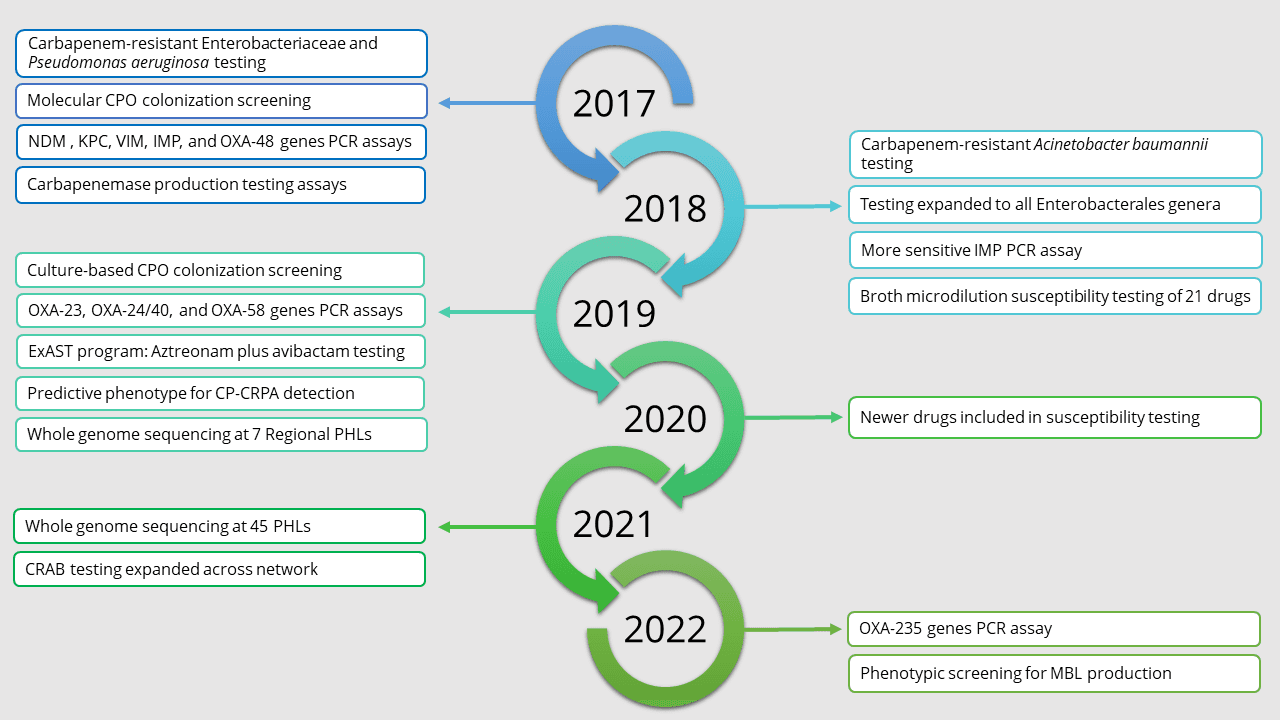
To improve our understanding of and ability to detect emerging AR mechanisms and healthcare-associated organisms, the AR Lab Network expanded antimicrobial susceptibility testing (AST) to include more reference techniques and testing of newer drugs. CDC developed and deployed new molecular detection assays to PHLs in the AR Lab Network and increased the adoption of accurate commercial platforms and assays to enhance sensitivity for a broader spectrum of carbapenemase genes and variants. CDC has also built capacity in whole genome sequencing (WGS) across the AR Lab Network, improving both sequencing techniques and analyses.
Figure 2: CDC DEVELOPMENT AND SUPPORT OF NEW AR LAB NETWORK TESTING TO ENHANCE DETECTION OF RESISTANCE THREATS IN HEALTHCARE-ASSOCIATED BACTERIA
Building Partnerships
In addition to enhancing reporting and improving laboratory methods, PHLs have built or improved multi-sector partnerships among state, local, and regional PHLs, CDC, submitting clinical laboratories, and professional societies. As a result of these improved partnerships, the AR Lab Network is dynamic and able to efficiently detect, respond to, and communicate emerging national AR threats. These collaborations improve our nation's resiliency during emergencies. This was demonstrated during the height of the nation's response to the COVID-19 pandemic. The pandemic had significant impacts on PHLs across the country, including laboratories in the AR Lab Network. Although it faced workforce reassignments, stay-at-home orders, supply shortages, and budget redirections, testing volume for AR Lab Network's HAI/AR threats still increased from 2019 through 2022. Its trained workforce, advanced diagnostic platforms, and existing test ordering and reporting infrastructure allowed for rapid redirection of testing by trained microbiologists to also accommodate the new pandemic demands.
Notable Discoveries and Findings:
AR Lab Network partnerships improve our nation's ability to work together to collect and characterize unique isolates and emerging antimicrobial-resistant organisms. The AR Lab Network, together with partnering Health Department HAI/AR programs across the country, identify and respond to multi-state outbreaks, discover novel AR threats, and communicate these findings to key stakeholders.
Examples of AR Lab Network`'s notable discoveries include:
- Detection of disseminated outbreaks
In 2022, AR Lab Network testing, including expansions in whole genome sequencing (WGS), helped identify a multistate outbreak of Carbapenem-resistant Pseudomonas aeruginosa (CRPA) harboring VIM and GES. The outbreak strain had never been reported in the United States prior to this outbreak. Investigation by CDC and state and local health department HAI/AR programs revealed most patients reported using an artificial tears product. CDC and FDA testing of the most commonly reported brand of artificial tears identified bacterial contamination. These findings resulted in a recall of implicated product in February 2023. In 2018, the AR Lab Network and public health departments helped identify an outbreak of extensively drug-resistant CRPA harboring VIM linked to medical tourism for bariatric surgery in Tijuana, Mexico. Investigators identified 38 confirmed or probable case-patients across 18 states and over 40% of case-patients required post-operative care in the United States as a result of their infections. WGS of epidemiologically linked isolates at CDC or AR Lab Network public health laboratories helped to link cases and track the outbreak.
- Detection of rare AR genes
Detecting and identifying carbapenemase genes, particularly those that have never or very rarely been found in the United States, helps improve patient safety and public health. Identifying the presence of a carbapenemase gives the treating clinician information on which drugs may prove effective for therapy and helps infection preventionists and health departments select or develop the right tools to identify additional cases. Through 2022, the Network has identified several rare carbapenemases, including SIM, FRI, and DIM.
- Detection of isolates harboring multiple carbapenemase genes
Between 2017 and 2021, the AR Lab Network identified 416 CRE isolates and 23 CRPA isolates carrying multiple targeted carbapenemase genes. Infections caused by organisms with multiple CP genes are an emerging concern in the United States and abroad. These infections may pose an even higher risk to patients because antibiotic treatment options may be further limited. Possible risk factors for infection with these multi-CP gene bacteria included recent history of international travel, international inpatient health care, and solid organ or bone marrow transplantation, as discussed in a 2021 manuscript.
- Detection of unusual organism/carbapenemase gene combinations
Several unique organism/carbapenemase combinations have been identified through AR Lab Network testing. Detecting such unique combinations gives clues about how carbapenemase genes move from one organism to another. Knowing whether certain organisms might carry these carbapenemases also helps laboratorians and clinicians understand what tests to run on these organisms to identify the carbapenemases and treat the infections they cause. Some examples of unique organism/carbapenemase combinations include: Klebsiella pneumoniae harboring Acinetobacter-associated OXA-23, CRAB and CRPA harboring OXA-48, and CRAB harboring VIM.
Maintaining Flexibility to Detect Emerging Threats
The AR Lab Network is always working to identify new and emerging AR threats, expand the nation's capacity to detect these threats, and protect patients and the public through enhanced colonization screening and characterization of AR threats. Together, these efforts inform clinical and public health actions and help shape testing and infection control recommendations. As a dynamic network built for rapid detection and response, the AR Lab Network is uniquely poised to help the nation prevent and respond to emerging AR threats.
References
- Containment Strategy
- About the AR Lab Network
- Health Department HAI/AR Programs
- VIM-CRPA Associated With Invasive Medical Procedures in Mexico (medscape.com)
- Extensively Drug-Resistant Carbapenemase-Producing Pseudomonas aeruginosa and Medical Tourism from the United States to Mexico, 2018-2019 - Volume 28, Number 1—January 2022 - Emerging Infectious Diseases journal - CDC
- Characterization of the First Carbapenem-Resistant Pseudomonas aeruginosa Clinical Isolate Harboring blaSIM-1 from the United States - PubMed (nih.gov)
- Carbapenem-resistant Enterobacterales (CRE) and Pseudomonas aeruginosa (CRPA) carrying multiple targeted carbapenemase genes
- Gram-Negative Bacteria Harboring Multiple Carbapenemase Genes, United States, 2012-2019 - PMC (nih.gov)